The Infield Ground Ball From First Read to Release
Reliable infield defense is a chain of movements, not a single act of catching the ball. The play begins before contact with positioning and a balanced ready move. It continues through the first read, the route to the hop, the way the fielder lowers the center of mass, and the presentation of the glove. Only then do the hands secure the ball, organize the feet, and deliver a throw suited to the runner and target. When one link is rushed, the next link inherits the problem: a poor route creates a difficult hop, a late glove creates a slow transfer, and crossed feet create an inaccurate throw. This step-by-step guide explains the repeatable mechanics behind routine ground balls while also showing how those mechanics adapt to backhands, forehands, slow rollers, double-play feeds, and balls that refuse to behave routinely.
A: No. Centering is ideal for many routine plays, but backhands, forehands, slow rollers, and range plays require different glove positions.
A: An extended but relaxed glove remains visible to the eyes, gives the hands room to absorb the hop, and supports a faster transfer.
A: Fielders usually prefer the predictable top of a short hop or the descending portion of a long hop and try to avoid the uncertain middle hop.
A: It should travel above the glove as the ball arrives, ready to secure the pickup and begin the exchange without blocking vision.
A: Low enough for the glove to reach the ground comfortably while the legs remain athletic and capable of moving in any direction.
A: No. The correct pace depends on the runner, ball speed, hop pattern, throw distance, and whether a force or tag is available.
A: A slight angle can place momentum and feet on a cleaner line toward the throwing target after the catch.
A: Fielders often secure the ball with feet that are stopped, crossed, or pointed away from the target, forcing the arm to compensate.
A: They should develop two-hand coordination on routine balls while learning that extended range plays may require the glove hand to work alone.
A: Locate the ball first, regain a stable grip, reset the feet, and make the strongest realistic play instead of rushing blindly.
Step 1: Set the Ready Position for the Actual Play
The ready position should prepare an infielder to move, not pose for a photograph. Feet begin slightly wider than the hips, knees and ankles remain flexed, and the chest leans forward without folding at the waist. The hands stay relaxed in front of the body. A small timing move as the pitch enters the hitting zone brings weight onto the front of the feet, but the move must finish early enough to allow an immediate step in either direction.
Depth and alignment change the mechanics before the ball is hit. A third baseman guarding against a bunt starts closer and expects a rapid forward break. A middle infielder at double-play depth prepares a route that preserves a feed to second. With two outs and a slow runner, the defense may gain depth to increase reaction time. Ready position is therefore the last piece of a positioning decision, not an identical stance used on every pitch.
Pre-pitch knowledge reduces panic. The fielder should know the number of outs, the force options, runner speed, and where the easiest out is likely to be. When the mind has already chosen the priority, the body can focus on reading the ball. Players who wait until the catch to locate the target often add extra steps or throw across their momentum.
Step 2: Read Direction, Speed, and Hop Pattern
The first read comes from contact: bat angle, sound, initial direction, and the ball’s first bounce. Infielders should avoid staring only at the ball’s present location. The useful target is the lane where the ball and fielder can meet on a manageable hop. A hard grounder may require a lateral angle and patient hands, while a slow roller creates pressure to shorten distance quickly.
Hop selection is a major difference between surviving ground balls and controlling them. A long hop provides time and usually descends predictably. A short hop is fielded near the ground soon after the bounce, before it can rise unpredictably. The middle hop is the uncomfortable space in between, where the ball can climb into the body or change direction late. Good routes create one of the first two options whenever time and field conditions permit.
Step 3: Arrive With Athletic Braking
Early strides cover ground, but the final steps organize the catch. As the infielder approaches the pickup point, stride length decreases and the feet make small adjustments. The hips lower gradually. Stopping suddenly causes the head to rise, the glove to drop late, and the feet to become stuck. Arriving under control preserves the ability to react if the last bounce changes.
Whenever possible, the fielder works from outside the ball toward the throwing target. That does not require a dramatic semicircle. One or two angle steps can place the left side of a right-handed thrower slightly closer to first, allowing the catch to flow into a directional move. On a range play, securing the baseball takes priority and the throwing alignment may have to be rebuilt afterward.
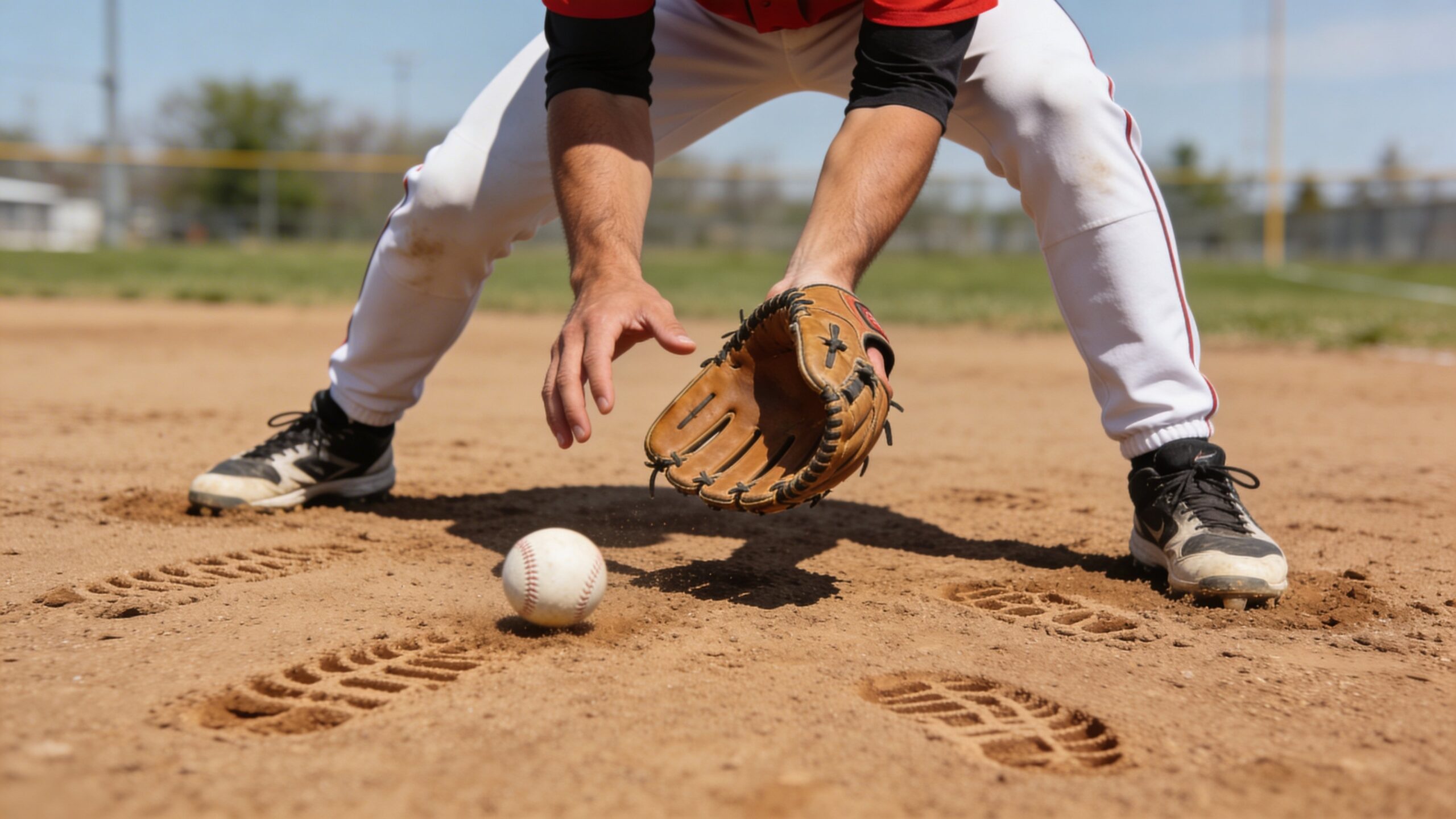
The head should remain relatively quiet through the final approach. Large vertical movement makes the bouncing ball appear less stable. Bent legs, rather than a collapsing upper body, lower the glove while keeping the eyes over the play. This posture also protects the face and chest by placing the glove and forearms in front.
Step 4: Present the Glove and Build a Barrier
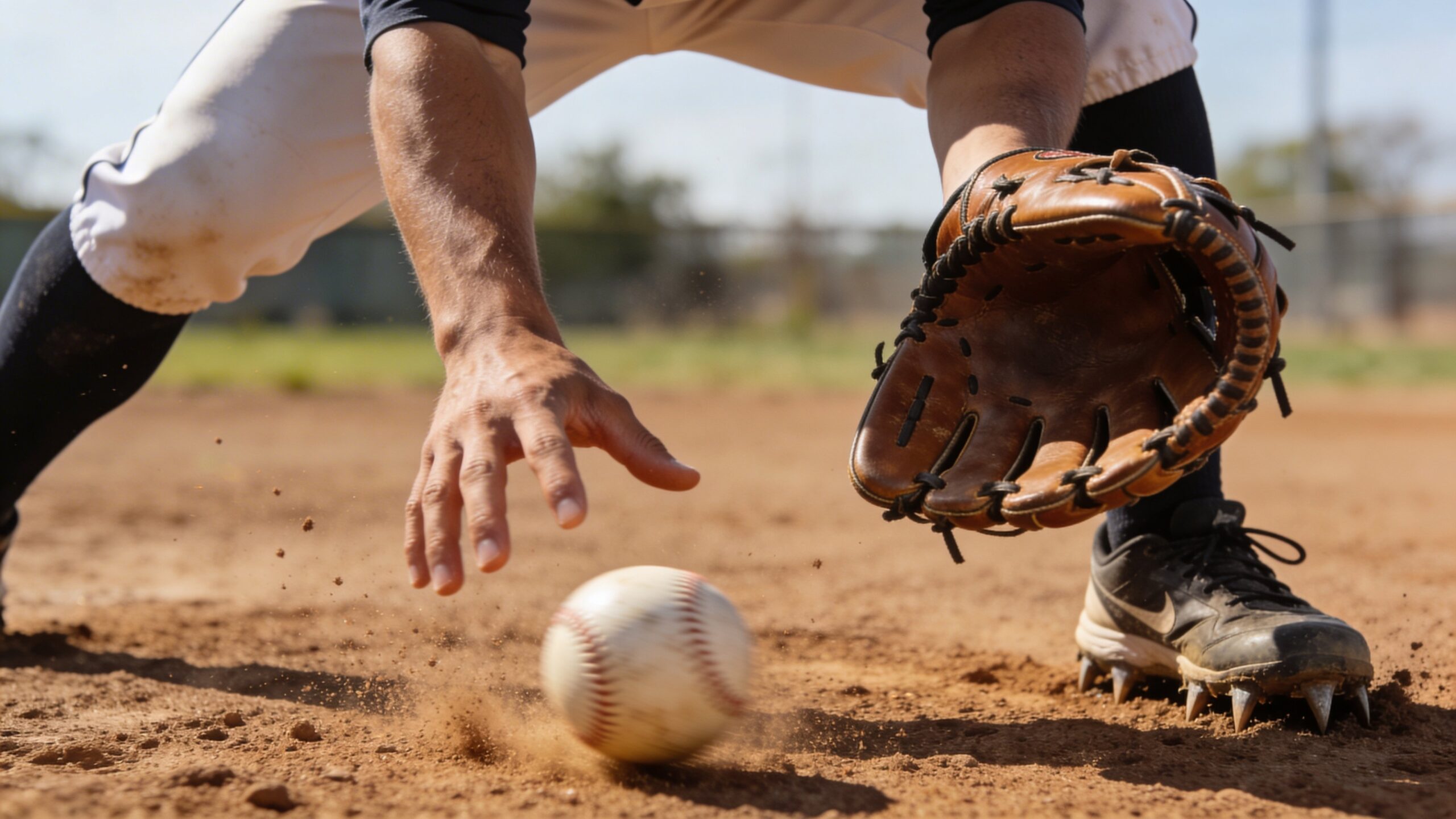
For a routine ground ball, the glove reaches forward between or just outside the feet with the pocket facing the approaching hop. The elbows remain soft. The throwing hand hovers above the pocket, close enough to secure the ball but not so close that it blocks the eyes. Bringing the glove too far beneath the body reduces reaction room; reaching with a locked elbow makes it harder to absorb pace.
The body supplies insurance. Should the ball take a small bad hop or escape the glove, bent knees and a squared chest can keep it nearby. This is why fielders are taught to get the body behind routine balls even when the glove is expected to make a clean catch. Knocking the ball down may still preserve an out, while allowing it to pass can turn one mistake into extra bases.
Hands receive rather than attack the ball. As it enters the pocket, the glove can give slightly with the impact. The throwing hand closes over the ball, and both hands move toward the center of the body. Looking the ball through the final portion of the catch prevents the common error of turning the eyes to first before possession exists.
Glove presentation changes with hop height without losing the same receiving idea. A ball climbing toward the belt may require the fingers to point upward, while a short hop keeps the pocket low and open through the bounce. The fielder should not flip the glove merely because the ball crosses an imaginary line. The pocket turns to meet the actual flight, and the body remains close enough to contain a miss.
Step 5: Transfer Through the Feet
The transfer is not merely taking the ball out of the glove. It is the moment possession becomes a throw. For a right-handed infielder moving toward first, the feet often flow right-left into the throwing position, though the exact sequence depends on direction and distance. The ball comes to the exchange area near the chest, the fingers find a usable grip, and the hands separate as the front side aligns with the target.
Finding four seams helps a throw carry straight, but a fielder cannot search so long that the runner wins the race. Routine balls offer time to feel across the horseshoe and organize the grip. On urgent plays, athletes may release with the best secure grip available and accept some movement. A stable wrist and throw through the target matter more than forcing a perfect grip after the play’s timing has expired.
Step 6: Match the Throw to Distance and Time
A routine throw across the diamond uses the legs and trunk, not an isolated arm. The fielder steps toward the target, rotates through a level shoulder line, and releases from a familiar window. Momentum continues forward after release. Throwing while falling away or spinning across the body magnifies small grip errors and forces the first baseman to handle unnecessary movement.
Shorter plays demand shorter actions. A second baseman close to first may use a compact arm stroke. A double-play feed can be underhand, backhand, or overhand depending on angle and distance. On a slow roller, the fielder may throw while moving, sometimes from a lower slot, because stopping would surrender the out. The principle is not to make every throw identical; it is to use the simplest action that can deliver a catchable ball in time.
Accuracy includes choosing the correct miss. Throws to first should generally pull the receiver away from the runner’s lane rather than into it. Feeds to second should arrive where the pivot player is moving. A firm chest-high ball often creates the quickest next action, but excessive velocity at short distance can slow the receiver. Great infield arms understand the teammate on the other end.
Adjusting for Backhands and Forehands
On a backhand, the infielder crosses over, arrives with the glove outside the lead foot, and keeps the head over the fielding area. The glove opens toward the hop without sweeping upward before the ball arrives. Some backhands flow into a planted throw; deeper range plays may require a jump throw or a complete foot reset. The athlete should earn those advanced releases only after learning to secure the ball with balance.
A forehand play begins with an aggressive crossover toward the glove side. Reaching too early causes the feet to stop while the ball continues away. Instead, the fielder runs to close space, lowers near the meeting point, and fields outside the glove-side foot. Momentum can then be redirected with a shuffle or replacement step. Balls near the line also require a quick fair-or-foul read before the player commits to a throw.
Both plays prove why routine mechanics are a foundation rather than a cage. The glove still works out front, the eyes still track the final hop, and the feet still organize the release. Only the body’s relationship to the ball changes.
Practice should alternate the two directions instead of allowing a player to favor the comfortable side. A coach can vary speed and distance while the fielder calls “forehand†or “backhand†during the first crossover. Naming the route reinforces an early decision. The goal is not identical technique on every ball, but a confident choice that places the glove and feet where the hop can be handled.
Handling Slow Rollers, Bad Hops, and Bobbles
A slow roller changes the priority from hop selection to time. The infielder charges with controlled forward lean, keeps the glove low during the final strides, and often fields outside the glove-side foot to preserve running momentum. A barehand pickup is appropriate only when a glove-to-hand transfer would clearly make the out impossible. The fingers approach from above and behind the ball, reducing the chance of pushing it forward.
Bad hops reward posture and patience. An infielder who has the body behind the ball can use the chest, shoulder, or forearm to keep a deflection close. After a bobble, the next move is not an immediate blind throw. The player locates the ball, secures it, checks the runner, and chooses the remaining play. Sometimes holding the ball prevents an error from becoming two bases.
Practice the Chain, Then Add Pressure
Mechanical practice should begin with predictable reps that isolate approach, glove presentation, transfer, and throw. Coaches can roll balls at different speeds and ask players to name the hop they intend to field. Once the movement is stable, reps should include live runners, changing force situations, and imperfect feeds. Decision speed develops only when practice requires decisions.
Quality matters more than exhausting volume. A useful set might alternate centered grounders, forehands, and backhands, followed by slow rollers and double-play feeds. Between reps, one precise cue is better than a list of corrections. If the glove is late because the hips never lowered, fixing posture may solve several visible symptoms at once.
Dependable infielders do not eliminate irregularity; they build a sequence that can absorb it. They prepare for the actual game situation, read the hop, arrive under control, receive the ball out front, connect the transfer to the feet, and deliver a throw their teammate can handle. Repeating that chain creates the calm appearance fans associate with elite defense—even when the ball takes an unfriendly bounce.