Baseball Conditioning Must Prepare Athletes for Explosive Repetition
Baseball is not a continuous-distance sport. Players accelerate for a few seconds, brake hard, rotate at high speed, throw from changing positions, wait, then reproduce the action later without losing attention or quality. A complete conditioning program therefore needs more than running poles or lifting heavy weights. It should develop usable strength, sprint speed, deceleration, lateral movement, rotational power, throwing readiness, joint capacity, and enough work tolerance to repeat skills across practices, games, travel, and a long season. The plan must also change with age, training history, position, calendar, and injury status. A catcher and center fielder share athletic foundations but face different volumes and postures; a developing teenager should not copy a professional workload. The framework below organizes training by purpose and season. Individual pain, rehabilitation, or medical conditions require evaluation and a program from qualified professionals who can assess the athlete directly.
Assess the Athlete Before Selecting Exercises
A program begins with the player’s calendar, positions, training history, growth stage, and health. Two athletes with the same age may tolerate different loads because one has trained for years and the other is beginning. The coach should know games, practices, throwing, private instruction, school activity, and other sports before adding work.
Testing should answer a programming question. A short sprint, jump, controlled strength assessment, movement observation, and basic work-capacity measure may establish a useful starting point. Testing everything creates fatigue and numbers without decisions. Choose measures that can be repeated safely and interpreted consistently.
Pain, recent injury, dizziness, unexplained weakness, or significant medical history changes the process. Screening is not diagnosis. Qualified medical professionals determine restrictions and rehabilitation, while performance coaches train within those boundaries.
Organize the Week Around Baseball Stress
Throwing, hitting, sprinting, lifting, and games all draw from recovery even though they feel different. A weekly plan should cluster high-intensity work intelligently and preserve lower-stress days. Placing heavy lifting, maximal sprinting, and a demanding bullpen on separate consecutive days may create more fatigue than combining compatible work and allowing recovery.
The athlete needs a plan that survives real schedules. Rainouts, doubleheaders, travel, exams, and extra innings will change the week. Establish priorities: games and essential skill work first, then the smallest conditioning dose that maintains progress. Missed accessory work is less damaging than forcing it into an already overloaded day.
Build General Strength With Repeatable Patterns
Strength gives athletes more force to express and more capacity to tolerate deceleration, contact, and repeated positions. The foundation includes squatting, hinging, splitting the stance, pushing, pulling, carrying, and trunk control. Exercise names matter less than safe execution, appropriate range, and steady progression.
Lower-body work should address both legs together and separately. Baseball contains asymmetric actions, but athletes still benefit from general bilateral strength. Split squats, step variations, and single-leg hinges reveal side-to-side control while squats and deadlift patterns allow larger force production.
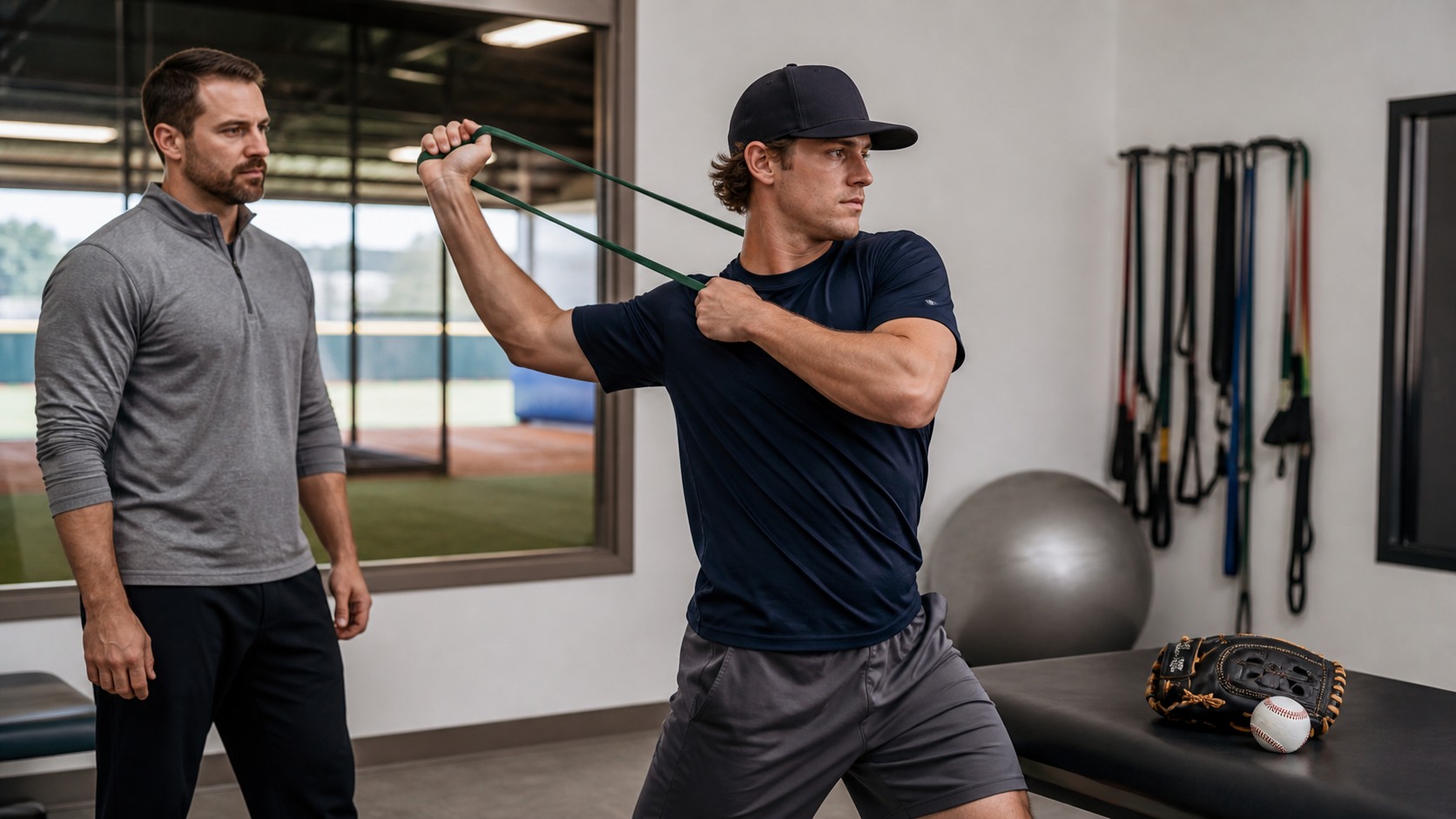
Upper-body training needs balance with throwing. Pulling and shoulder-support work can build the back and scapular musculature, while pressing should respect the athlete’s comfort, mobility, and current arm volume. No lift is mandatory. If an exercise causes pain, the solution is not to prove toughness through it.
Progression can come from better technique, greater range, additional load, faster intent, or more repetitions. Change one main variable at a time. Young and novice athletes often improve through consistent practice with modest resistance long before complex methods are necessary.
Train the Trunk to Transfer and Resist Force
The trunk connects force from the ground to the arms and bat. It must rotate quickly in some actions and resist unwanted extension, side bend, or rotation in others. A complete plan includes both functions rather than performing endless high-speed twists.
Anti-extension exercises teach the athlete to control the rib cage and pelvis. Anti-rotation presses and carries build stability against external force. Side-support variations develop lateral control. These qualities create a platform for power without trying to freeze the body during actual baseball movement.
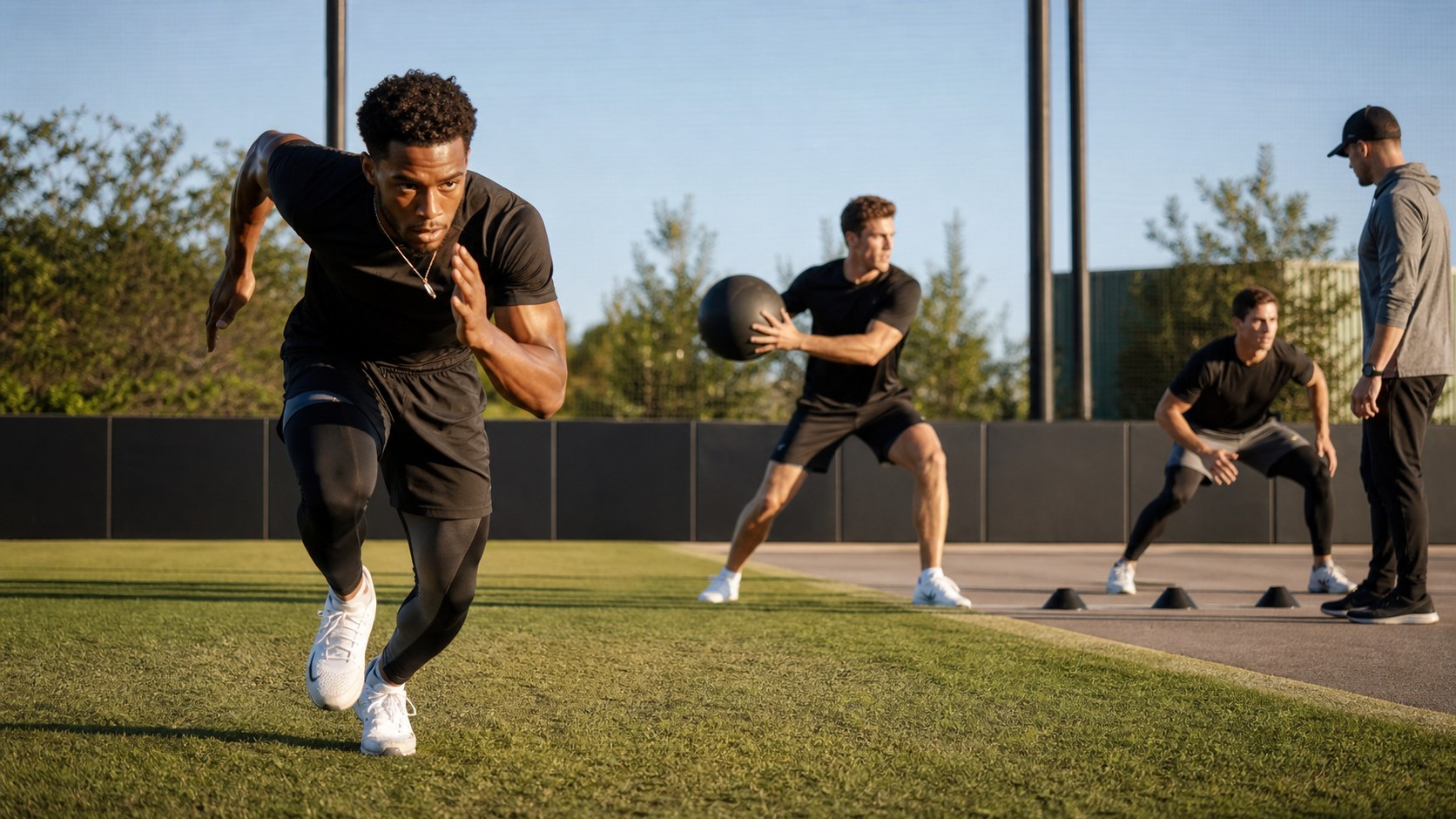
Medicine-ball throws can then express rotation, transfer, and braking at speed. Direction should vary: scoop throws, shot-put patterns, step-behind throws, and overhead options each solve different tasks. Athletes need space, a safe wall or partner setup, and balls light enough to move explosively.
Develop Acceleration for Baseball Distances
Most baseball sprints are short. The first several steps decide a stolen base, infield hit, or route to a gap. Acceleration training should emphasize forceful projection, coordinated arms, and rising gradually rather than standing upright immediately.
Starts can reflect the sport: batting stance, lead at first, crossover from the outfield, or ready position. Sport-specific starts should follow basic acceleration work, not replace it. Athletes first learn to push and organize, then apply the skill to varied postures.
Full recovery preserves speed. If every sprint begins while breathing heavily and ends slower, the session becomes conditioning instead of speed development. Rest can feel long, but the quality of each rep is the training signal.
Distances can range from a few explosive steps to longer runs that match extra-base or outfield demands. The exact menu depends on position and space. Quality declines before motivation does, so coaches should stop when posture and times show that speed is no longer being trained.
Teach Deceleration Before Demanding More Agility
Changing direction requires the ability to absorb force. Players must lower the center of mass, use several controlled braking contacts when needed, and keep the foot from reaching far beyond a position the body can manage. Deceleration drills make stopping a trained skill. Planned cuts allow technical learning because the athlete knows the direction and can focus on approach speed, foot placement, and reacceleration. Reactive drills come later, adding a visual or ball cue; skipping directly to chaos can hide poor braking behind enthusiasm.
Baseball agility includes curved paths. Rounding first, angling to a fly ball, circling a grounder, and backing up a base are not cone zigzags. Drills should include arcs, depth changes, crossover steps, and decisions that preserve vision of the play. Not every drill needs maximal competition. Some sessions teach movement at controlled speed; others test it against a partner or live ball. The program alternates learning and expression so players can move quickly without abandoning the solution.
Produce Power Without Accumulating Sloppy Volume
Power is the ability to express force quickly. Jumps, bounds, medicine-ball throws, Olympic-lift derivatives where well coached, and fast intent on selected strength exercises can develop it. Power work belongs early enough in the session that fatigue does not turn explosiveness into slow repetition.
Landing quality matters as much as takeoff. Athletes should absorb force with control and be able to reset. Repeated loud, unstable landings signal that the set is too long, the height too great, or the task too advanced.
Medicine-ball volume should remain purposeful. Ten excellent throws can be more useful than fifty that lose sequence. Coaches can change direction and stance across the week rather than asking one session to contain every rotational variation.
Condition the Energy Systems Baseball Actually Uses
Players need repeated high-intensity efforts with substantial rest, plus enough aerobic fitness to recover between them and across the week. Short sprints, shuttles, baserunning intervals, and position-specific movement can train repeatability. Work-to-rest ratios should preserve mechanics appropriate to the session’s goal.
Low-intensity aerobic work has a place. Easy cycling, tempo movement, brisk walking, or controlled running can support general fitness and recovery for some athletes. It should complement, not replace, sprint speed and power. A player can be good at long slow work while remaining unprepared for explosive baseball.
Game conditioning is also created by practice. Live defense, baserunning reads, and competitive hitting contain accelerations and attention demands. Adding a hard conditioning circuit after an already dense session may provide fatigue without a missing adaptation.
Catchers require repeated squatting, rising, blocking, and short bursts; outfielders need occasional longer accelerations; pitchers need delivery repeatability and recovery between high-intensity throws. General fitness supports all positions, but the final conditioning dose should respect their distinct workloads.
Integrate Throwing Instead of Treating It as Free Activity
Every throw contributes to arm stress, particularly high-intensity pitching, long-distance throws, pulldowns, and hard position work. A conditioning calendar should show throwing beside lifting and sprinting. Otherwise, the athlete can appear to have a light gym day while completing a demanding arm session elsewhere.
After time off, throwing should build gradually through comfortable distance, volume, and intensity. Competitive urgency does not change tissue readiness. A player who can throw one hard ball is not necessarily prepared to repeat it across innings.
Strength sessions near pitching can emphasize lower body, trunk, or carefully chosen upper-body work depending on the individual. The objective is not avoiding all fatigue; it is ensuring the most important throwing sessions can be executed with normal movement and command.
Use Mobility Where It Improves a Real Position
Mobility is useful when a limitation prevents the athlete from reaching or controlling a needed position. Ankles influence squatting and deceleration, hips affect running and rotation, and thoracic movement contributes to throwing and swinging. The assessment should identify the target rather than prescribing the same stretching circuit to everyone.
Mobility without control may not transfer. Pairing a range exercise with strength or movement in that range teaches the athlete to use it. Warmups can include dynamic mobility, while longer relaxed work may fit later sessions. More range is not always better when the sport requires stiffness and stability too.
Growing athletes can feel temporarily tight as bones and tissues change. Aggressive stretching is not a competition. Consistent comfortable work, strength through useful ranges, and professional evaluation for persistent limitation are safer than forcing motion.
Pitchers with altered arm motion or pain should not attempt to stretch their way through the problem independently. The cause may not be where symptoms appear. Medical and performance professionals can determine whether mobility, strength, workload, technique, or another factor needs attention.
Plan Recovery as an Active Part of Training
Sleep is the most powerful routine recovery tool. Nutrition and hydration support the work performed, while light movement can help athletes feel prepared between sessions. Recovery products cannot compensate for chronically insufficient sleep or an overloaded calendar.
Monitoring can be simple: soreness, energy, motivation, sleep quality, throwing feel, and performance trend. A single poor day is normal. Several declining signals together suggest that volume or intensity should change. Athletes must be able to report honestly without punishment.
Deloads reduce planned stress before fatigue becomes a longer problem. They can use fewer sets, shorter sprints, lower throwing intensity, or additional days off. Reducing work temporarily does not erase adaptation; it often allows the existing training to appear.
Shift Emphasis Across the Baseball Year
In the offseason, game stress is lower, allowing more strength development, movement teaching, and progressive speed work. Throwing may include a true break and later build according to the athlete’s needs. The offseason is not simply the regular season with more workouts.
Preseason converts general gains into baseball timing and repeated skill. Practice and throwing volume rise, so gym volume often falls. Conditioning becomes more specific, and athletes need enough live situations to prepare attention as well as bodies.
In season, maintenance can be achieved with brief high-quality exposures. Two efficient lifting sessions may preserve strength better than one exhausting marathon. Speed work can use a small number of sprints on suitable days. The goal is readiness for games while preventing physical qualities from disappearing.
After the season, athletes need transition. Some benefit from complete competitive rest, other sports, and movement variety. Review injuries, workload, and performance before building the next plan. A calendar that never ends cannot create distinct phases.
Build a Sample Week From Priorities, Not a Universal Template
Consider a position player with two weekend games. Early week may contain the largest strength session and acceleration work, followed by skill practice. A second moderate strength and power session can occur later, while the day before competition uses short preparation. Throwing and team practice determine the exact placement.
A starting pitcher’s week revolves around the outing and recovery response. Bullpen, catch play, strength, sprint work, and mobility are arranged to support the next start. Relief pitchers need more flexible plans because availability changes daily. No printed sample can replace communication about actual use.
Young athletes with school and multiple sports may need only two short structured strength sessions plus team activity. More is not automatically more advanced. The complete program is the smallest sustainable dose that improves the required qualities while leaving enough capacity to practice and play baseball well.